
Nation Sites
The Nation Network
The LeafsNation has no direct affiliation to the Toronto Maple Leafs, Maple Leaf Sports & Entertainment, NHL, or NHLPA
2016-17 Leafs Season in Review: William Nylander
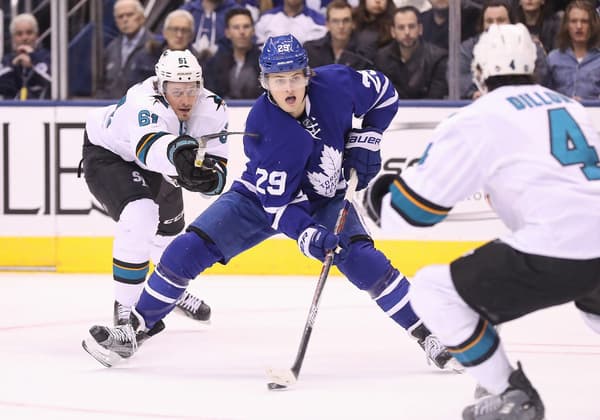
Photo credit: Tom Szczerbowski/USA TODAY SPORTS

Jun 9, 2017, 11:47 EDT
Unlike the other two big rookies on the Leafs, fans already had an idea of what they were getting from William Nylander, as they got a taste of what he brought to the team in the 2015-16 season after the deadline, where he, and many other rookies, replaced the veterans that had been traded. He certainly impressed, with 13 points in 22 games, including six goals.
With an idea of the kind of player Willie was, he had relatively high expectations going into the season. He fulfilled them almost immediately, with 11 points in the first nine games of the season, and then took his game to a whole new level down the stretch, as he put up 14 points during a late-season 12 game point streak.
Despite getting traded by the media every day, Nylander managed to push those aside and show the world that he belongs in Toronto, capturing many fans hearts (including mine) in a way that compares to our old friend Philip Joseph Kessel Jr. Hopefully, Willie spends most of his career in Toronto, though.
Strengths
Where do I begin? First, let’s talk about his amazing playmaking skills. Nylander has vision and passing skills that give him a huge advantage over the competition. It doesn’t matter where the other player is, he can find a way to put it on his stick. It’s what makes him lethal on the power play, as he is able to set up just about anyone on the ice for a great scoring chance. There’s a reason why he was second in rookie assists (behind Mitch Marner) and tied for 35th overall (with Evgeni Malkin!), as he finished with 39 of them, 17 of them on the power play.
The other thing that makes him lethal on the power play is his shot. It makes life for the opponent extremely difficult knowing that he can make amazing passes, or pick a corner on a goalie just as easily. It doesn’t seem to matter about the angle, as long as there is an opening big enough to fit a puck. He finished the year with 22 goals, which was fourth among rookies, and tied for 70th overall.
Also, his hands. Oh god, his hands. Watch his highlights from the World Championships, and you will see what I mean. Whether it’s deking out a goalie in tight or using his skating to blow past opponents, he has the ability to make the other team look silly. His hands, shot, and passing skills are a rare, but dangerous trio that gives him a step above the competition. And this is just his first year!
Defensively, he appears to be off to a good start. He finished the season with a 52.4% 5v5 CF%, which was fourth on the team. Some of that is geared more towards his strong ability to generate offence (his 63.42 5v5 CF60 led the Leafs, and was 27th in the whole league), his shot suppression wasn’t too bad relative to the team, as his 57.66 5v5 CA60 was 10th on the team. All this while playing a decent chunk of the season on the Kadri-Komarov shutdown line.
Does he have any other strengths? Of course, just look at his beautiful face. He even cracked the first line on fellow LeafsNation writer Dylan Fremlin’s all-vanity team. It’s hard enough to play against him with his talent, never mind the fact that you’ll get distracted by his amazing looks.
Weaknesses
Of course, Willie isn’t perfect (yet). His aforementioned CA60 is a bit high to be considered amazingly good defensively, but considering his role on the shutdown line for a bit, as well as the fact that this is his first full season, it’s a bit understandable.
My other concern was his unimpressive outing at centre this season. While a really small sample size, especially considering he was on the fourth line, he didn’t perform very well at centre when Babcock put him there during Bozak’s injury. He seemed a bit out of place, which is surprising since he played centre in 2015-16. However, this is really nitpicking, since it was, again, a small sample size. But, it might be a concern, especially if there are still plans to put him at centre down the road.
Looking Ahead
It’s crazy to think about how amazing Nylander was this year, and then remember that this was his first full season in the NHL. While he has an extra year of development over Matthews and Marner, there were times where Nylander could dominate the game, especially down the stretch when the games mattered.
Going into next season, it wouldn’t surprise me if he takes another step forward offensively. Considering that he had the fourth-worst shooting percentage among forwards on the team, and the third lowest on-ice shooting percentage among all skaters, it wouldn’t shock me if Nylander had a “rebound year”, and shot at a better rate than last year.
If he really were to regress, this would mean that he probably is in the 70 point range next year, including possibly hitting 30 goals, but I feel like that’s a lot to expect from a player in his second year. I feel like he probably produces similarly to last year, while a lot more of his development comes from the defensive aspect of his game, to become that much better for the Leafs down the road.


Breaking News
- Ben Danford credits Marlies’ coaching staff for helping transition to pro hockey
- Maple Leafs sign prospect goaltender Timofei Obvintsev to 1-year AHL contract
- New coaches, front office changes, and forward options: Leaflets
- Ben Danford sets sights on Maple Leafs’ opening-night roster: Leafs Morning Take
- Toronto Marlies re-sign Ken Appelby, Sam Stevens, ink 5 more players to contracts

Toronto Maple LeafsTeam Cap Summary

Cap Summary
2026-27
2027-28
Projected Cap Hit
$106,752,382
$106,752,382
Projected Cap Space
-$2,752,382
$6,747,618
Current Cap Space
-$2,752,382
$6,747,618
Active Players
23/23
24/23
Draft Picks
Round
'26
'27
1
1
1
2
1
2
3
4
0