
True: the Toronto Maple Leafs don't generate nearly as many chances off-the-rush as they did last season, or relative to other teams this season (27th per game). False: the Leafs don't score a lot off-the-rush (1st per game). The Leafs have the highest shooting percentage in Show more

Nation Sites
The Nation Network
The LeafsNation has no direct affiliation to the Toronto Maple Leafs, Maple Leaf Sports & Entertainment, NHL, or NHLPA
Why the Leafs should temporarily ignore north-south hockey to continue offensive surge
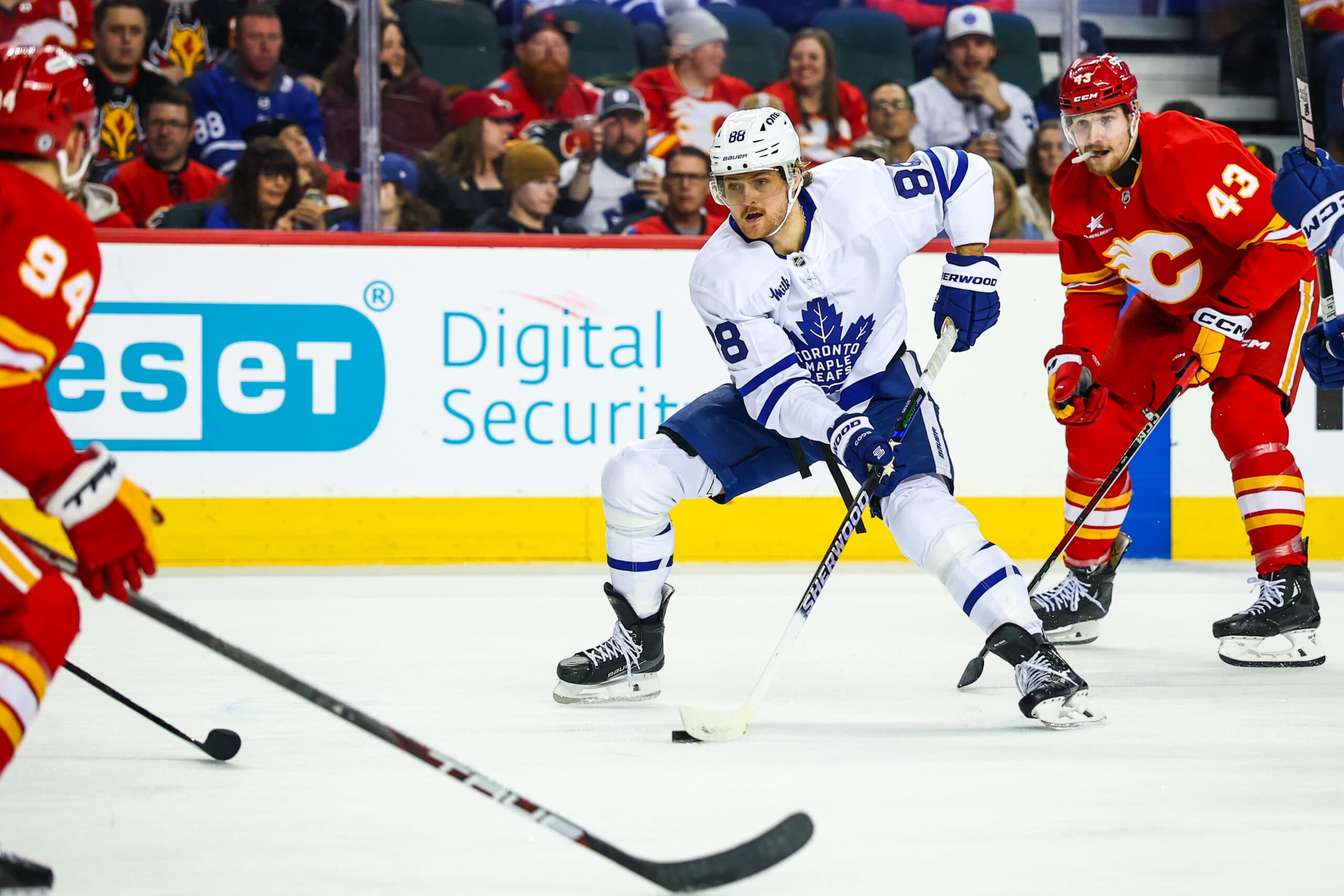
Photo credit: Sergei Belski-Imagn Images

Feb 6, 2025, 14:30 ESTUpdated: Feb 6, 2025, 14:23 EST
Toronto Maple Leafs head coach Craig Berube is on a mission to revamp his team’s style of play during his first year with the club and thus far, it has largely worked. Under Berube’s supervision, Toronto has morphed into a club that prioritizes simplicity, with an adherence to ‘north-south’ hockey, as the team plays with vertical lines and often pursues the puck through dump-and-chase, rather than maintaining possession at all costs.
Although the Maple Leafs have committed to sound defensive structure, it hasn’t been perfect as the team was getting torched off the rush through December and January, Morgan Rielly is showing diminishing returns (although he responded with an excellent performance in Tuesday’s 6-3 win over the Calgary Flames) and Toronto’s offence has largely dried up at 5-0n-5. Last season, the Maple Leafs led the NHL with 200 goals at 5-on-5. This year, Toronto is tied for 14th with the Montreal Canadiens, Los Angeles Kings and New York Islanders ahead of Thursday’s games, with 105 goals at 5-on-5.
Considering that the Maple Leafs boast some of the greatest offensive talent in the NHL, this is a nearly untenable outcome. And while Berube’s adherence to north-south hockey could prove instrumental during the playoffs, Toronto broke out of its rigid structure against the Edmonton Oilers on Saturday, and again during Tuesday’s comprehensive win against the Calgary Flames, which helped unlock its offensive potential.
Mike Kelly of NHL Network found that the Maple Leafs rank 27th in rush chances per game, while ranking first in goals per game off the rush in the league. This isn’t particularly surprising, but it encourages the Maple Leafs to occasionally break structure and become more inventive when their opponent can’t contain the neural zone. William Nylander likely leads the NHL in breakaway chances — any casual observer of the league has noticed that Nylander seemingly slips behind the defence once every two games at minimum — while Bobby McMann’s elite straight-line speed has paid dividends during a breakout campaign. Auston Matthews can excel in any offensive situation and ranks within the top 100 in rush attempts at 5-on-5 despite missing 15 games, as he can power through defenders while entering the offensive zone.
Nylander and McMann are both adept at punishing teams for making mistakes, when they’re encouraged to use space in the neutral zone and attack liberally. Here are two examples from Tuesday’s win, where the Maple Leafs convert defence into instant offence — to say nothing of Nylander stripping MacKenzie Weegar of the puck for a game-sealing hat-trick with the empty net.

Bobby McMann makes Calgary pay for the turnover with a snipe on the odd man rush! #LeafsForever
William Nylander again, 4-2 Maple Leafs! #LeafsForever
And here’s a bonus example, when Matthews picked off an errant Flames pass, charged up the ice, and Matthew Knies cleaned up the rebound. Toronto played freely, it emphasized puck possession at all costs and ripped into a Calgary team that is fighting valiantly for a wild-card spot.

MATTHEW KNIES 🚨 Clean up on aisle goal! 20th of the season!
Risk aversion in the playoffs is a necessary detail, to be clear. Berube was brought in, in large part due to the fact that his preferred style of play is diametrically opposite to Sheldon Keefe’s free-wheeling offence, that allows Nylander, Matthews and company to showcase the variety of their scintillating skill set. And this isn’t also meant to preach taking risks at all costs, either. Toronto’s sound defensive principles ought to go a long way, but a strict adherence to Berube’s system when the goals aren’t flowing doesn’t make a ton of sense either. If the worry is about how the team will score during the playoffs, breaking out of rigid structure, temporarily, may be the key.
We don’t want to be revisionist, either. Toronto won Saturday’s thriller against Edmonton because of Joseph Woll’s heroics in net, but it did play a free-form style of play against one of the NHL’s most dangerous teams which boasts two Hart Trophy winners in Leon Draisaitl and Connor McDavid.

look this is going to sound nuts with 50 minutes remaining but I love this matchup, Oilers are forcing the Leafs to play up-tempo, break out of passive habits and an adherence to risk-averse, north-south at all costs. McDavid and Draisaitl will get their looks, keep shooting!
Mitch Marner is a player who embodies two-way excellence, and is two years removed from a Selke finalist nomination. He’s also at his best offensively when he’s allowed to create freely, and he scored an outright sensational goal off the rush against the Oilers to start the third period on Saturday, which stood as the game-winner.
the puck movement *chefs kiss*
If the regular season is meant to be an audition for the playoffs, then the Maple Leafs have acquitted themselves well. The past two games have allowed the Maple Leafs to find their flow at 5-on-5, and the power play is converting at a 32.4 percent clip since January 1. This could be instructive to players like Max Domi and Nick Robertson as well, who have often struggled to find their offence — Domi especially — while adapting to a style of play that dictates Toronto play in vertical lines, hounding down pucks after getting through the neutral zone.
Berube and his staff won’t want to hear it, and we’ll defer to them when it comes to tactics, but a temporary break from structure has unlocked some strong offensive results for the Maple Leafs. It’ll be compelling to see whether this approach continues after the 4 Nations Face-Off break.
Sponsored by bet365


Recent articles from Arun Srinivasan
Breaking News
- Easton Cowan was the positive surprise for 2025-26 Maple Leafs, should thrive under Jim Hiller
- Around the NHL: Jets continue Connor Hellebuyck trade talks, Patrick Kane linked to 2 teams
- Former Maple Leafs goaltender Dennis Hildeby reflects on career with Toronto following trade to Lightning
- Matthew Tkachuk lists Leafs’ Sergei Bobrovsky as ‘backbone’ of Panthers’ Stanley Cup-winning teams
- Who is the Maple Leafs’ ideal defensive partner for Darren Raddysh?

Toronto Maple LeafsTeam Cap Summary

Cap Summary
2026-27
2027-28
Projected Cap Hit
$106,752,382
$106,752,382
Projected Cap Space
-$2,752,382
$6,747,618
Current Cap Space
-$2,752,382
$6,747,618
Active Players
23/23
24/23
Draft Picks
Round
'26
'27
1
1
1
2
1
2
3
4
0