
Gus Forsling Stanley Cup Final mix 8 minute defensive masterclass on the PDOcast Youtube channel: bit.ly/4050l9u

Nation Sites
The Nation Network
The LeafsNation has no direct affiliation to the Toronto Maple Leafs, Maple Leaf Sports & Entertainment, NHL, or NHLPA
What the Leafs can learn from the Florida Panthers: Gustav Forsling’s clinic on cutting off point of attack
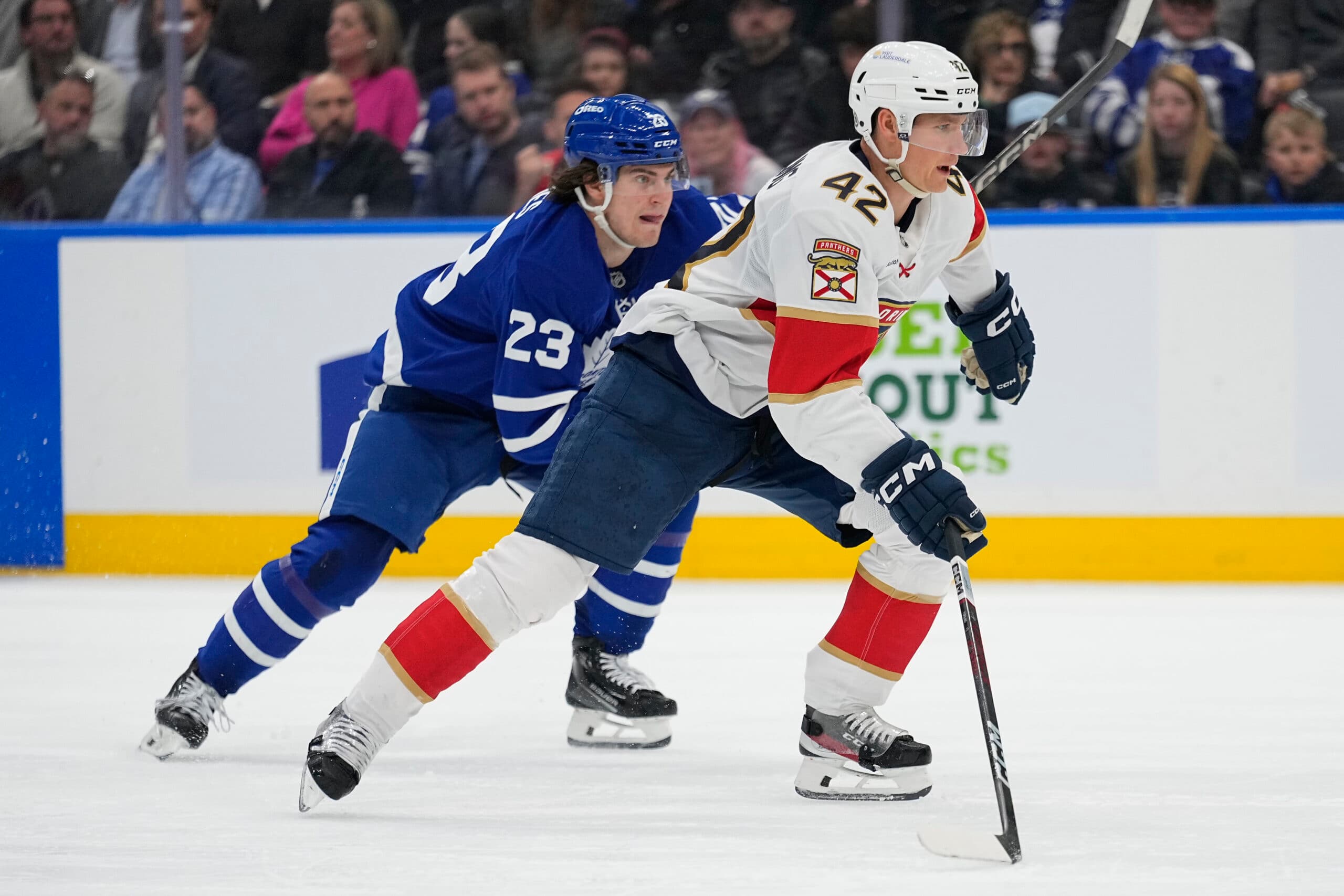
Photo credit: John E. Sokolowski-Imagn Images

Aug 12, 2025, 09:00 EDTUpdated: Aug 12, 2025, 01:00 EDT
Transitive property isn’t a real method of evaluation and while the Toronto Maple Leafs may have lost in seven games to the Florida Panthers, there are plenty of lessons to be learned from the back-to-back champions. Toronto may have provided Florida with its toughest test during the 2025 Stanley Cup Playoffs, but it is still at least a tier or two away from replicating the prolonged success of its divisional rival.
We’ll go through a few notes and caveats: namely, there are few exceptional qualities the Panthers have and not all of it is replicable. Carter Verhaeghe’s breakaway speed or Aleksander Barkov’s proficiency in the faceoff circle aren’t traits that can be picked up over the summer. What we’re trying to identify are things the Panthers did well, that the Leafs can incorporate into their games. At the very least, this exercise will explain what the champions do extraordinary well, without resorting to empty platitudes of ‘toughness’ or ‘wanting it more’ or whatever the war of attrition de jour is.
In the first part of this series, we’re going to start by examining Panthers star defenceman Gustav Forsling and how his game serves as a clinic on cutting off the point of attack.
Forsling is a superstar and is the NHL’s best defensive defenceman, with consideration to Carolina Hurricanes standout Jaccob Slavin. Some would argue that Maple Leafs defender Chris Tanev deserves contemplation for this superlative, but Forsling’s skill set is different. While Tanev is arguably the NHL’s best shot-blocker with a terrific ability to exit his defensive zone cleanly, Forsling is the best man-to-man defender in the league, he anticipates shooting lanes off the rush with clarity (you don’t need to look much further than how he defended Connor McDavid in consecutive Finals as proof of concept) and there are clearly identifiable parts of his game that the Leafs should try to adopt for the 2025-26 season.
Dimitri Filipovic of The PDOcast released an eight-minute supercut of Forsling’s play against McDavid and the Oilers in the 2025 Final. A picture is worth a thousand words, and Forsling’s ability to track the puck clearly stands out. Whether it’s a 2-on-1 where Forsling has to expertly position himself between two potent shooters, or reading the puck off McDavid’s stick when he’s flying through the offensive zone with unmatched pace, the 29-year-old never gets rattled. Forsling’s game is particularly instructive in rush scenarios.
“Rush defence. I think that’s always a concern for every team, though,” Maple Leafs head coach Craig Berube said on January 5, when asked about what his team needs to improve entering the second half of the season. “It’s such a fast league. Teams transition so quick and the D are always up in the play. Just some better sort outs. I think there are a lot of times where we can manage the puck better and not give up opportunities to teams the other way. We’re getting better at it, trust me. I think our team has bought into putting the puck deep, and going to work, but there’s still improvement to be made.”
Toronto struggled in rush defence scenarios throughout the year, and it was one of its biggest flaws overall. Tanev and Jake McCabe were granted an exemption in my January piece which identified the team’s difficulties on the counterattack, the former serving as the Leafs’ best overall defenceman, while the latter operated as the team’s premier point-of-attack defender. Andrew Brewer, who joined the Anaheim Ducks as an assistant coach this summer, outlined how Forsling uses his elite stick positioning to rotate well and defend the rush better than anyone. Florida built its dynasty in large part due to its outstanding possession and puck retention, and Forsling’s ability to win back the puck before it enters the defensive zone is a major component of its proficiency.
When you defend & pivot with 1 Hand on your stick, your ability to move, open up, rotate either way is increased. Gustav Forsling might be the best Defenseman in the NHL to teach young players how to defend skating forward! Clips made in Studio by @Hudl

Notice how the first player who has two hands on his stick knocks over half the cones, and the players behind him don’t When you have 2 hands it hinders your dexterity and flexibility making it harder for hips to open up! Keep 1 hand on your stick until it is needed!!
And while Forsling’s tracking ability, his underrated propensity to create offence from turnovers, and dynamic skating should be admired by Morgan Rielly and Brandon Carlo, Tanev and McCabe aren’t infallible, either. No one is expecting Tanev to become a secondary scorer (although he did register his best offensive campaign since the 2019-20 season) but the Maple Leafs received minimal offensive contributions from their blue line, and Forsling will absolutely wire the puck when given the chance. Don’t be fooled by Forsling’s relatively pedestrian point production after recording 11 goals and 31 points in 80 games, he is a superstar.


Gustav Forsling gives the Panthers the lead! 😼
It should be remembered that Toronto allowed the third-fewest (136) goals at 5-on-5 last season, while Florida allowed the fourth-fewest (139) so perhaps major overhauls aren’t required. Forsling’s game still provides enough instructional value and points to the idea that suppressing the opponent before it can get set up in the offensive zone, rather than working tirelessly to facilitate a quick zone exit is the more efficient approach. Perhaps this is common sense, too, but Forsling makes the game look easy. Every team in the league would do well to examine Forsling’s approach to defending the rush, allowing him to cover the ice with relative ease, while taking pointers from his ability to track the puck, even when carried by the NHL’s most dangerous talents.
Toronto appeared to panic during Game 5 and 7 against Florida. Forsling is the embodiment of calm and cool, he creates offence from turnovers, he’s always well-positioned, he’s an underrated physical presence and his stick work is unmatched. There may be small tweaks to the Leafs’ defensive system in year two under Berube and while he’s likely not seeking outside counsel, Forsling’s game may provide the blueprint for an extended playoff run.
Sponsored by bet365


Breaking News
- Adam Copeland believes John Chayka has already quieted some critics: Leafs Morning Take
- It’s time to put the Matthew Knies trade rumours to bed
- Around the NHL: Canucks reportedly Shane Wright’s preferred destination
- 8 non-Maple Leafs NHL free agency stories you may have missed
- Easton Cowan was the positive surprise for 2025-26 Maple Leafs, should thrive under Jim Hiller

Toronto Maple LeafsTeam Cap Summary

Cap Summary
2026-27
2027-28
Projected Cap Hit
$106,752,382
$106,752,382
Projected Cap Space
-$2,752,382
$6,747,618
Current Cap Space
-$2,752,382
$6,747,618
Active Players
23/23
24/23
Draft Picks
Round
'26
'27
1
1
1
2
1
2
3
4
0