
Nation Sites
The Nation Network
The LeafsNation has no direct affiliation to the Toronto Maple Leafs, Maple Leaf Sports & Entertainment, NHL, or NHLPA
5 reasons why Leafs-Panthers series is tied through four games
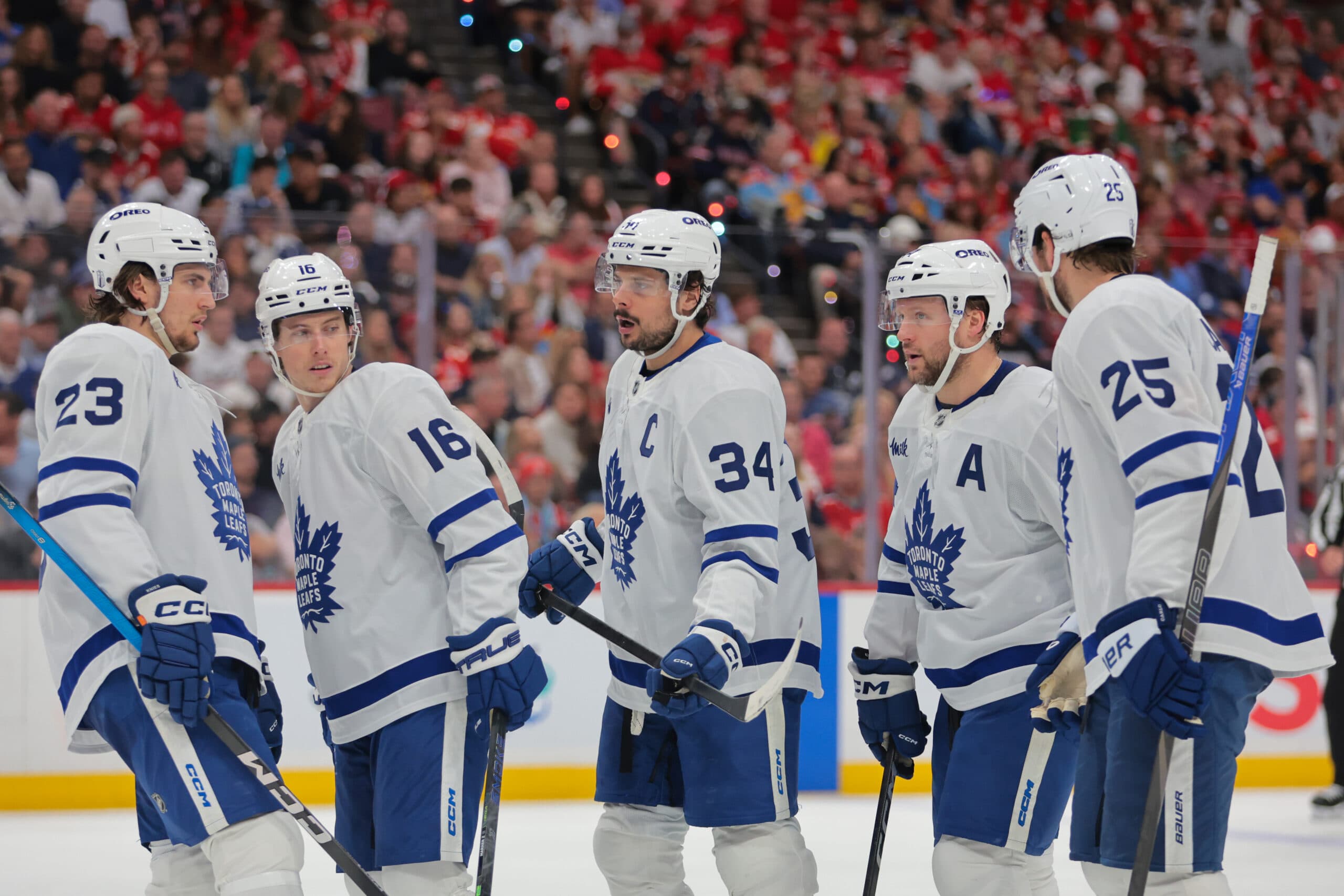
Photo credit: Sam Navarro-Imagn Images

May 14, 2025, 06:00 EDTUpdated: May 13, 2025, 13:37 EDT
They say it isn’t a series until the road team wins a game, so we’ll have to disagree with conventional thinking here, as the Toronto Maple Leafs and Florida Panthers are firmly entrenched in a battle that is shaping up to be an instant classic.
Toronto won the first two games on home ice, capturing Game 1 convincingly, before holding on for a Game 2 victory. Florida responded with an overtime win in Game 3, with Brad Marchand notching the overtime goal, before blanking Toronto entirely in a controversial Game 4.
Florida entered the series with championship pedigree, a firmly established defensive system that clogs up the neutral zone and the institutional knowledge of what it takes to win it all. Toronto bolstered its depth at the deadline, to augment a Core Four group that hasn’t advanced the second round of the playoffs, despite boasting an array of offensive talent that would be the envy of most teams.
Here are five reasons why the Leafs-Panthers series is tied through five games.
Expected goals aren’t translating into actual goals for Matthews, Marner
Toronto’s first line of Matthew Knies, Auston Matthews and Mitch Marner are largely playing well throughout the series. Knies-Matthews-Marner have outscored the Panthers 5-2, boast a plus-four shot differential and a 54.3 share of the expected goals at 5-on-5. And yet, Matthews and Marner simply need to score more often. Matthews is getting into the high-danger areas, but he’s only registered one goal in four games, while Marner’s offence has a goal and two assists in the series but did not register a shot in either Game 3 or 4. It’s safe to say that the 22-year-old Knies has been the Maple Leafs’ best player on the star-studded line.
It’s not something the Leafs are worried about, but Matthews’ long-range shooting appears to be affected, and there has been a demand for the Maple Leafs’ captain to approximate the form he reached last year when he notched 69 goals during the regular season. As for Marner, he does a lot of things that don’t show up on the scoresheet, but after a miserable Game 4 where he failed to produce anything of consequence, the noise will be dialled up, especially after he enters the summer as a pending unrestricted free agent.
William Nylander has exceeded expectations, and John Tavares is coming up clutch throughout the series as well. Matthews won his matchup handily against Aleksander Barkov in Game 1, but the Panthers have adjusted, and Seth Jones has done an excellent job as the primary defender on Toronto’s captain. The process may be working and their defensive impact has been stellar, but Matthews and Marner need to bury more pucks in this best-of-three.
Panthers won transition battle in Game 3-4
Toronto sped through the neutral zone through the first two games of the series, killing Florida in transition. It was an unexpected development, given the Panthers’ reputation for minimizing chances and forcing opponents to the outside. Perhaps there is something to be said for home ice advantage, as the Panthers corrected their mistakes, and made it impossible for the Leafs to generate any chances with real pace, especially during Game 4.
Seth Jones was particularly active in this regard, swatting down a few Leafs’ home run passes — particularly from Marner — through the neutral zone. Jones has been the primary defender on Matthews throughout the series, and at times, he’s roamed around like a free safety. Florida is also doing a better job of converting on Toronto’s mistakes. Sam Bennett took advantage of a poor turnover from William Nylander, and when Jake McCabe and Chris Tanev didn’t communicate well in space, Bennett swooped in for an easy goal.
It’s been an up-tempo series for the most part, but you could reasonably anticipate a much grittier style of play through the closeout games in this series, where winning in transition may become a vital factor. It’s been an even split through the first four games, with the pendulum shifting towards the Panthers.
Leafs’ lack of depth scoring
The onus may be on Matthews and Marner to score more often, but the Leafs’ lack of depth scoring is the team’s most consistent issue this year. Bobby McMann, Scott Laughton, Pontus Holmberg, Steven Lorentz and Calle Jarnkrok are all searching for their first postseason goal, 10 games into the playoffs. McMann is particularly notable as he scored 20 goals during the regular and boasts elite straight-line speed that should lend itself well to scoring chances. Laughton has been strong defensively throughout the playoffs and while the acquisition cost still makes sense, he’s due for a huge goal as well.
Florida are finding contributions across the board and its depth players are out-perfoming Toronto’s bottom-six corps. The series will be won by the stars, but within the margins, the Leafs are losing the battle.
The thin margin between Woll and Bobrovsky
Joseph Woll was thrust into the starter’s role after Anthony Stolarz was injured in Game 1 and provided a range of performances during his first three games. Woll closed out Game 1, he didn’t need to be at his best in Game 2, he struggled throughout Game 3, allowing a series of soft goals, before responding with an outstanding performance in a Game 4 loss. Woll has saved 0.3. goals above expected this postseason while his counterpart, Sergei Bobrovsky, has saved -1.6 goals above expected in all situations via MoneyPuck.
Two summers ago, Bobrovsky caught fire and was simply unbeatable as the Maple Leafs fired a barrage of chances his way and couldn’t solve the two-time Vezina winner. Bobrovsky isn’t anywhere close to his top form, but he could return to his all-world powers on a moment’s notice, while Woll is improving as the series goes on. It’s been a thin margin thus far, but while the Panthers boast the more experienced goaltender, who has won it all before and has been the best goaltender in the playoffs for the past two years, Woll has been marginally better in the series. It may be up to Woll, after all.
Leafs have temporarily abandoned a simple, direct approach to the power play
Toronto’s power play is at its scintillating best when it resets at the top and allows Marner to morph into quarterback mode. It allows for Marner to survey the ice, while Tavares crashes down from the bumper spot, and Knies causes havoc at the net-front. Toronto has abandoned its simple strategy during the past two games, seeking optimal looks for Matthews and Nylander, while Florida clogs up the passing lanes.
It can be all so simple, and it’s what Berube wants. If there isn’t a clear look, reset at the top! Marner has been part of the problem, trying to force shots through traffic from the point that have been often swatted for odd-man rushes. Some of the problems have stemmed from passive entries as well, as it’s clear that the Leafs’ strategy of skating at half-speed to centre ice before dropping the puck back to its entrant allows the opponent to set up their defence way too easily. Get pucks to the net, allow Tavares and Knies to jam away at rebounds and good things will happen. We’ll see if the Leafs go back to their formula that allowed them to boast the NHL’s second-best power play after February 1, during the regular season.
All stats from NHL.com and Natural Stat Trick
Sponsored by bet365


Recent articles from Arun Srinivasan
Breaking News
- Matthew Tkachuk lists Leafs’ Sergei Bobrovsky as ‘backbone’ of Panthers’ Stanley Cup-winning teams
- Who is the Maple Leafs’ ideal defensive partner for Darren Raddysh?
- Ben Danford credits Marlies’ coaching staff for helping transition to pro hockey
- Maple Leafs sign prospect goaltender Timofei Obvintsev to 1-year AHL contract
- New coaches, front office changes, and forward options: Leaflets

Toronto Maple LeafsTeam Cap Summary

Cap Summary
2026-27
2027-28
Projected Cap Hit
$106,752,382
$106,752,382
Projected Cap Space
-$2,752,382
$6,747,618
Current Cap Space
-$2,752,382
$6,747,618
Active Players
23/23
24/23
Draft Picks
Round
'26
'27
1
1
1
2
1
2
3
4
0