
Auston Matthews since March 1, via Natural Stat Trick in all situations: 1st in shots (42) individual scoring chances (49) 2nd in individual expected goals (5.28), tied for 2nd in goals (6) 6th in points (12) Tied for 8th in individual scoring chances (18)

Nation Sites
The Nation Network
The LeafsNation has no direct affiliation to the Toronto Maple Leafs, Maple Leaf Sports & Entertainment, NHL, or NHLPA
Auston Matthews did all the small things well, upper-body injury clearly affected elite shooting, scoring
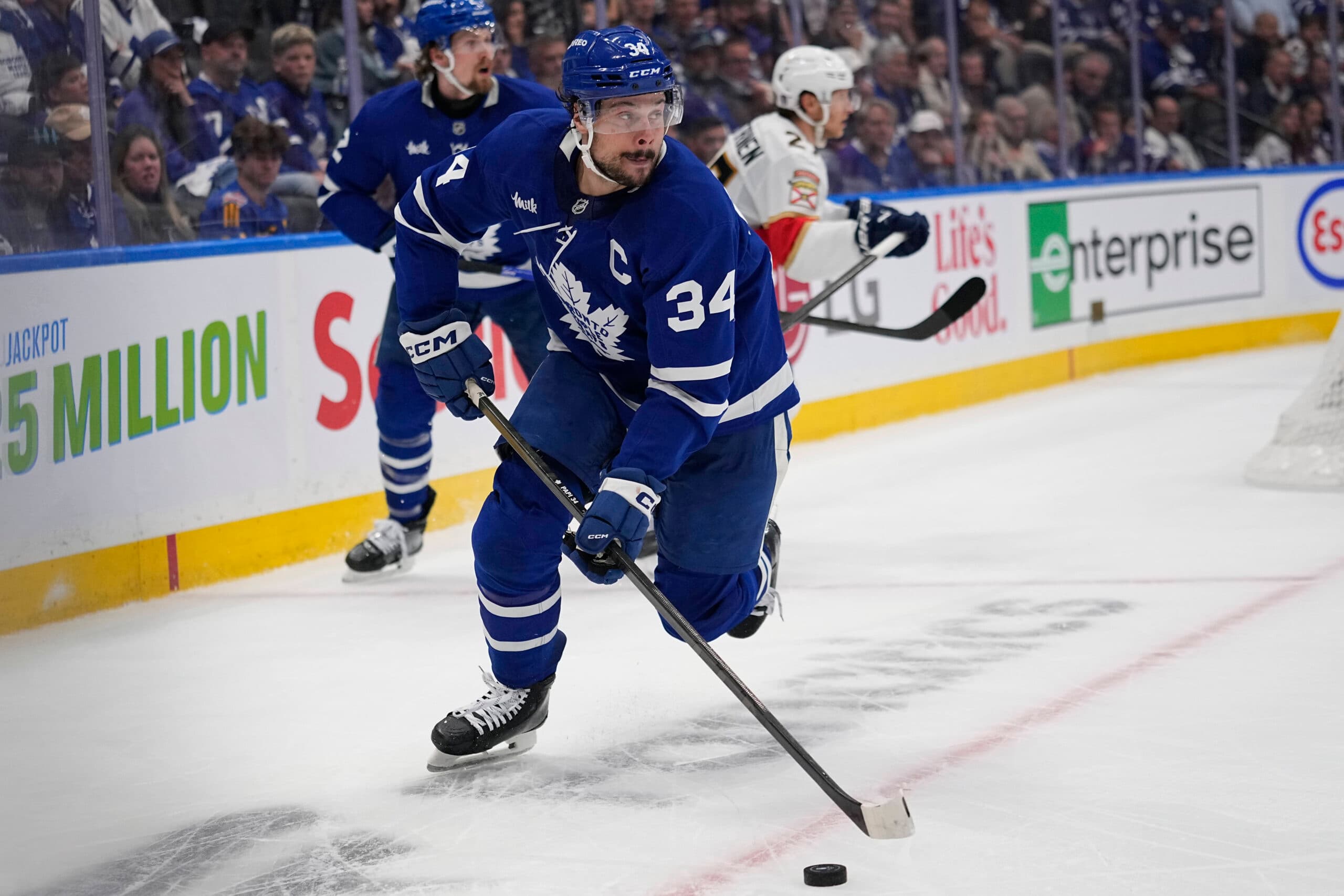
Photo credit: John E. Sokolowski-Imagn Images

May 29, 2025, 07:30 EDTUpdated: May 29, 2025, 08:45 EDT
Toronto Maple Leafs captain Auston Matthews was clearly affected by an upper-body injury that he suffered during training camp, which hampered his elite shooting and scoring abilities more than anything. Matthews did all the small things well, pushed his way into high-danger areas and provided elite defensive impact, but his offensive production paled in comparison to his career-best 2023-24 campaign, where he notched 69 goals and 107 points.
Figuring out the extent of Matthews’ injury was arguably the trickiest part of being on the Leafs beat this past year. Matthews skated and shot with his normal pace and velocity during morning skates, but would labour through games during particular stretches of the year, including a mid-December stint. The unspecified injury appeared to flare up during the playoffs as well, while Matthews registered three goals and 11 points in 13 postseason games, as the Maple Leafs were ousted in seven games by the Florida Panthers.
“It’s a very tough season, I don’t need to get into the specifics of stuff, but it happened to me in training camp, obviously wasn’t feeling great for the first month or so of the season,” Matthews said at the Maple Leafs’ end-of-year media availability on May 20. “I took some time off, went to Germany, all of these things to try and feel better, than, you know, just kind of in a place that I felt like I could manage it.”
It was the first year of Matthews’ captaincy and it was a mixed season for a player capable of operating as the best shooter alive. Matthews still produced 33 goals and 78 points in 67 regular season games, but it pales in comparison to the stratospheric standard he’s set since entering the league.
How the year went
Matthews left the Leafs’ morning skate on September 24 without prior warning, causing some consternation among fans and the press. Maple Leafs head coach Craig Berube downplayed the severity of the injury, telling reporters that his captain was fine, referring to the ailment as an ‘upper-body thing’ and it appeared to be a non-story throughout training camp.
The 27-year-old was held scoreless through the Maple Leafs’ first three games, prompting baseline questions about shooting regression and turning expected goals into actual goals, a theme that resonated throughout the season. Matthews broke out during the Maple Leafs’ 6-2 victory over the Los Angeles Kings on October 16 in a three-point performance, then added goals in Toronto’s next two games.
Matthews was still fighting through the injury and was placed on injured reserve on November 8, retroactive to November 3. After missing nine games, Matthews returned to the lineup on December 1, but he clearly wasn’t playing up to his usual standard. After taking a hit from Buffalo Sabres defenceman Dennis Gilbert, Matthews re-aggravated the injury. He returned to the Leafs’ lineup on January 4 in an explosive performance against the Boston Bruins and remained a permanent fixture in the lineup from there onwards.
For the vast majority of players, Matthews’ 2024-25 campaign would represent an excellent season. And it was an typical season, as Matthews lead Team USA to the 4 Nations Face-Off final, losing to Team Canada in overtime.
Matthews appeared to be all the way back in March, but he couldn’t score with the same volume that was expected of him, largely because he couldn’t rip his wrist shot with the same force and accuracy from medium and long-distance ranges. He was also missing routine chances in front of the net and his shooting accuracy was affected, while working on his wraparound in practice sessions.
During the postseason, Matthews and the Maple Leafs eliminated the Ottawa Senators in six games. Against the defending champion Florida Panthers, it was incumbent upon Matthews and Mitch Marner to elevate their games in order for the Maple Leafs to advance. Matthews scored a critical goal in Game 6, but his offence completely dried up in Game 5 and 7, one of the enduring images of an exasperating season.
Matthews is now tasked with taking the summer off, fully recovering and returning to the form where he established himself as the best shooter alive.
Statistical profile
Category | Production | NHL rank |
Expected goals percentage, 5-on-5 | 53.19% | 146th |
Goal differential, 5-on-5 | +14 | 93rd |
Corsi, 5-on-5 | 52.12% | 174th |
Expected goals for per 60, 5-on-5 | 2.93 | T-63 |
Expected goals against per 60, 5-on-5 | 2.58 | 422nd |
Individual expected goals | 18.94 | 9th |
Shooting percentage | 9.38% | 275th |
All stats at 5-on-5 via Natural Stat Trick
The good news: Matthews was getting to the high-danger areas at an elite rate, as his individual expected goals at 5-on-5 can attest to. Berube emphasized getting pucks to the net and crashing down at the net-front, where Matthews may have been instructed to change his approach to attacking the offensive zone.
The bad news: Matthews’ shooting regressed badly and while he was lauded for winning puck battles throughout the season and playoffs, it didn’t always translate to strong defensive impacts, as evidenced by his expected goals against per 60. This doesn’t always account for the board battles won and his improved positional sense, but there is still a lot of area for improvement from Matthews on the defensive side of the puck, which can be viewed in a positive light, given that he finished third in Selke voting last season.
Matthews scored 10 power play goals this season, in a tie for 34th overall league-wide. Toronto’s power play fluctuated throughout the season, eventually finishing at a 24.8 percent success rate, the ninth-best mark in the NHL. Matthews in some ways is a microcosm of the power play: when his shot is clicking and he’s getting into high-danger areas with ease, the Maple Leafs look like one of the NHL’s most dangerous offensive teams. When Matthews can’t fire his shot with the same accuracy and velocity that he’s become known for, the offence drops off, and the Maple Leafs’ power play will be carefully examined entering next season — it’s more than likely Matthews will be operating without Marner for the first time in his career.
If this is a down year for Matthews — and we can’t imagine a further drop off in form during the prime of his career — the Leafs should be in good shape, while entering a summer that could present plenty of change for the forward corps overall.
Select highlights
Matthews’ power play goal, Calgary Flames, March 17

ST. PAPI ☘️
Matthews’ opening goal, Game 6 vs. Florida Panthers, May 16

AUSTON MATTHEWS OPENS THE SCORING 🎥TNT #LeafsForever
Sponsored by bet365


Recent articles from Arun Srinivasan
Breaking News
- Matthew Tkachuk lists Leafs’ Sergei Bobrovsky as ‘backbone’ of Panthers’ Stanley Cup-winning teams
- Who is the Maple Leafs’ ideal defensive partner for Darren Raddysh?
- Ben Danford credits Marlies’ coaching staff for helping transition to pro hockey
- Maple Leafs sign prospect goaltender Timofei Obvintsev to 1-year AHL contract
- New coaches, front office changes, and forward options: Leaflets

Toronto Maple LeafsTeam Cap Summary

Cap Summary
2026-27
2027-28
Projected Cap Hit
$106,752,382
$106,752,382
Projected Cap Space
-$2,752,382
$6,747,618
Current Cap Space
-$2,752,382
$6,747,618
Active Players
23/23
24/23
Draft Picks
Round
'26
'27
1
1
1
2
1
2
3
4
0