
🇺🇸 USA GOAL 🇺🇸 Brady Tkachuk scores the first goal for the US at the Four Nations Faceoff! 🎥: Sportsnet | NHL #USA #Finland

Nation Sites
The Nation Network
The LeafsNation has no direct affiliation to the Toronto Maple Leafs, Maple Leaf Sports & Entertainment, NHL, or NHLPA
Canada-USA preview: A clash of styles on full display in 4 Nations Face-Off marquee
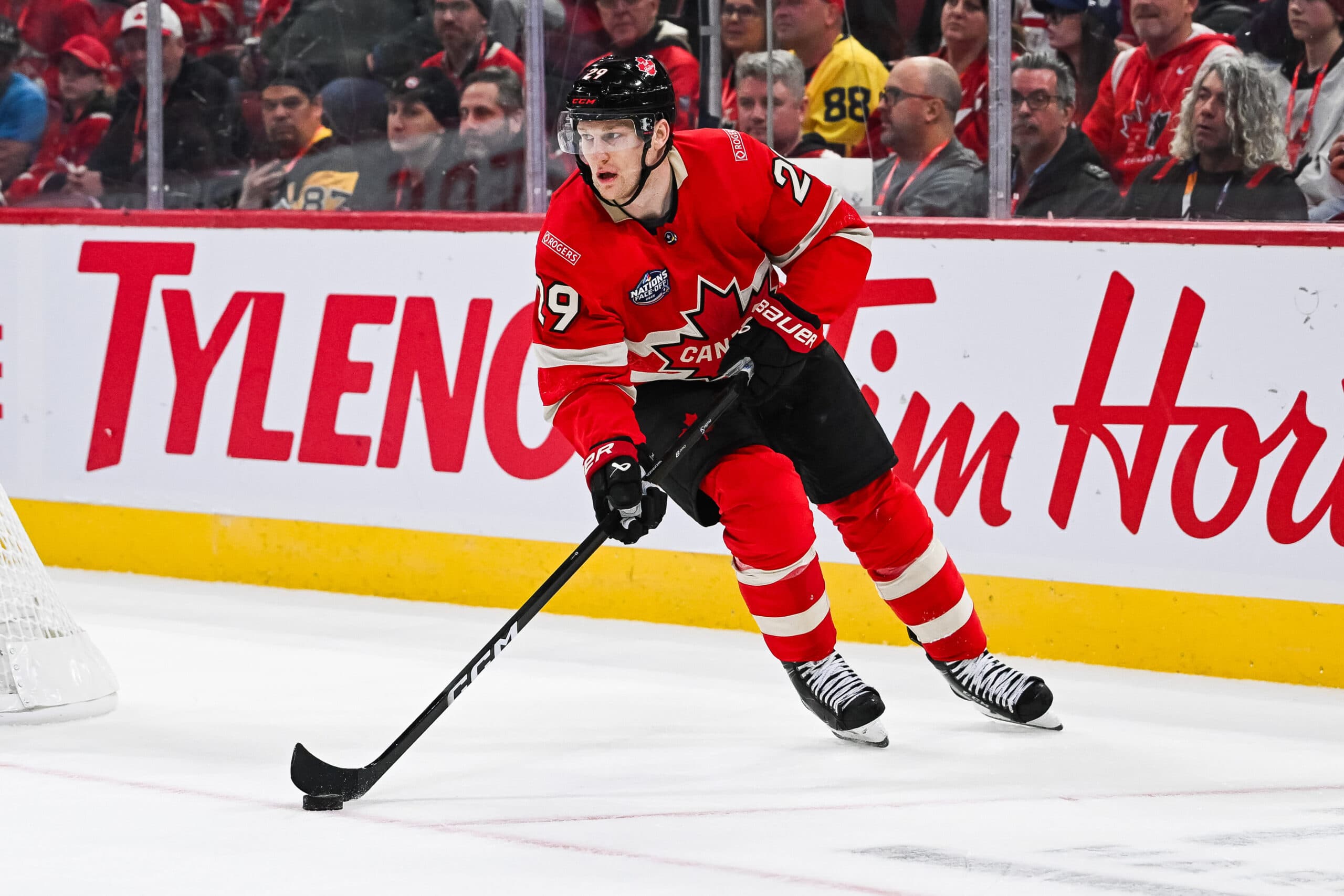
Photo credit: David Kirouac-Imagn Images

Feb 15, 2025, 06:00 ESTUpdated: Feb 15, 2025, 13:25 EST
A primetime clash between Canada and USA was always going to be the marquee event of the 4 Nations Face-Off, but it should be a thrilling matchup that extends outside of bragging rights, hockey rivalry and geopolitical conflict.
Both teams are considered the co-favourites, and the United States have pulled into pole position after throttling Finland 6-1 win on Thursday, while Canada sits in second after needing overtime, and a Mitch Marner wondergoal to dispatch Sweden 4-3 in the tournament opener.
This game also presents a true clash of tactics, which should ought to elevate the most anticipated men’s international contest of the past decade to a new level.
USA’s adherence to north-south structure, physicality could control possession battle
Brady Tkachuk and Matthew Tkachuk led USA’s attack in a 6-1 victory over Finland, using their trademark physicality to bully opponents in a commanding win. The Tkachuk brothers are the modern vision of a prototypical power forward and they’re among the best players in the world at getting to the net-front, creating easy opportunities from high-danger areas. And these qualities aren’t just limited to the Tkachuk brothers. They were placed alongside Jack Eichel, who generates tremendous power from his one-of-one, upright gait. Tkachuk, Tkachuk again and Eichel all controlled over 85 percent of the expected goals at 5-on-5 against Finland, and while Canada boasts a far superior defence, they have the ability to hem any opponent in its own end, create tons of chances off the cycle, and in stationery scenarios.
It’s not that the Americans can’t win off the rush: Brady Tkachuk scored his second goal of the game, cutting through Finland’s defence with ease, running a give-and-go with Eichel to perfection. Jake Guentzel combined with Auston Matthews to score off the rush directly from the opening faceoff during the third period, while Jack Hughes’ speed and opportunism is a handful for the best defenders in the world, and Canada may be without Cale Makar, who missed Friday’s practice due to illness. Matthews can bully his way to high-danger areas: he’s arguably the world’s best player at getting into high-danger areas, while the threat of his shot creates tons of space for his linemates.
It’s also worth mentioning that Zach Werenski leads all 4 Nations entrants in rush chances at 5-on-5 during the NHL season, and can activate off the rush as well as any player in the tournament — save for Makar, perhaps. Werenski finished with three assists against Finland and is in the form of his life, a threat that Canada will have to account for, as he could swoop in from the blue line as an extra attacking option.
USA’s bottom-six can also win at the net-front — Matt Boldy tipping home Brock Faber’s point shot is a fine example — while Brock Nelson and J.T. Miller are capable of playing with a nasty streak. It will be compelling to see how Dylan Larkin is used in this contest, as his all-world speed is an asset against a Canadian team who will try to win with superior skill and improvisational ability.
Jaccob Slavin is the best player in the tournament at mitigating chances and he forms arguably the best shutdown pair in the competition alongside Adam Fox. They may get stapled to Canada’s virtuoso line featuring Sidney Crosby — easily the best player on the ice during Wednesday’s game — Nathan MacKinnon and Mark Stone — with the focus of keeping Crosby and MacKinnon at bay and facilitating zone exits as cleanly as possible.
This is the best men’s roster that the United States have ever fielded, and it’s largely because of their adherence to a north-south, physically engaging structure, an unmatched chemistry largely built from the United States National Team Development Program (USNTDP) a defence corps that can enter the rush and break up chances with equal fluency, and of course, the tournament’s best goaltender in Connor Hellebuyck. It will pose the toughest test this Canadian core has ever seen.
Canada may be at its best playing out of structure, relying on superior skill and rush offense
A roster boasting Connor McDavid, Nathan MacKinnon and Sidney Crosby shouldn’t be intimidated by anyone, but the United States pose a unique test and Canada is responding accordingly. Jon Cooper has tweaked his lines, so Brayden Point, Anthony Cirelli and Brandon Hagel will be paired together, an all-world combination of defensive acumen and elite speed.
Cirelli and Hagel are two of the NHL’s best defensive forwards, while Point is a bonafide scorer with blazing pace that can navigate small spaces better than virtually any player in the tournament. It’ll be compelling to see if Cooper line matches the all-Lightning line against the Tkachuk brothers and Eichel, or if he deploys them against the Guentzel-Matthews-Hughes combination. It’s a compelling counteraction to the United States’ adherence to a physical style of play, where it will try to send several bodies into the net-front and make life hell below the slot.
Canada played to a dead-even possession share against Sweden and it may be forced to counterattack against the United States. It may be for the best: Canada appeared to play its best hockey out of structure, or on the power play, where the MacKinnon-Crosby-McDavid scoring punch left Sweden in a daze. Marner scored his game-winner flying in off the rush, taking a drop pass from Crosby before depositing an expertly placed shot into the low corner, Brayden Point and Brad Marchand connected off the rush for Canada’s second goal, while Crosby and Mark Stone converted defence into instant offence, when Stone stripped William Nylander, Crosby raced up the ice, and found a cutting Stone for Canada’s third goal.
Canada’s top line of McDavid, Marner and Sam Reinhart boasts the world’s best skater, this year’s leading Selke candidate in Reinhart (Seth Jarvis was the Selke favourite through the first quarter in my opinion, for what it’s worth) and Marner, an all-around forward who is capable of two-way excellence when he’s at his best. Perhaps this is where we’ll see a much anticipated matchup between Matthews and Marner. Marner seems like an ideal candidate to face-guard Hughes, Matthews and McDavid can go head-to-head outside of a McDonald’s campaign, while Reinhart will be tasked with cancelling out Guentzel, in a renewed Atlantic clash of sorts. United States may be superior in its power game, but Canada should be expected to generate real offence from the counterattack.
Cale Makar could miss Saturday’s game due to illness, although the team appears confident he will suit up. Thomas Harley is eligible to play for Canada if Makar is indeed ruled out, after Shea Theodore suffered an upper-body injury in Thursday’s opener, where he’ll miss the remainder of the 4 Nations Face-Off. Josh Morrissey took reps on the power play in Makar’s absence, a natural power play quarterback, and it’ll be compelling to see how he works in tandem with MacKinnon, Crosby and McDavid, although the prevailing logic is that you merely need to be competent when working with the trio of the game’s premier offensive talents.
Colton Parayko struggled against Sweden and Travis Sanheim will be inserted in the lineup in Theodore’s absence. Travis Konecny took reps alongside Devon Toews in practice as an alternate, which won’t happen during a game, and it seems likely Harley could factor in alongside Toews on a makeshift top pair. Drew Doughty has been a staple of Canada’s core for the past 14 years, but he’s returning from injury and noted that Wednesday’s contest was the fastest-paced game he’s ever played in. No offence to a dynamite Sweden squad, but the United States have an extra gear across the board, and there will be an emphasis on quick exits and springing the counterattack, while keeping the opponent away from the net-front at all costs.
Jordan Binnington will get his second consecutive start, but the United States boasts a clear advantage between the pipes. Canada has more than enough talent to shoot the lights out against anyone, but it may have to operate from the rush and counterattack in order to suppress an American team hell-bent on controlling possession and keeping the puck away.
All stats from NHL.com and Natural Stat Trick

Daily Faceoff Live is on the road! From February 10th to 20th, we’re bringing you live shows every weekday straight from Four Nations, delivering exclusive coverage, insider analysis, and all the tournament action as it unfolds. Don’t miss a beat—subscribe to the Daily Faceoff YouTube channel and follow us on social for the latest updates. It’s international hockey, so expect intensity, excitement, and maybe even a little chaos. Stay locked in and catch us live from Four Nations!


Recent articles from Arun Srinivasan
Breaking News
- Easton Cowan was the positive surprise for 2025-26 Maple Leafs, should thrive under Jim Hiller
- Around the NHL: Jets continue Connor Hellebuyck trade talks, Patrick Kane linked to 2 teams
- Former Maple Leafs goaltender Dennis Hildeby reflects on career with Toronto following trade to Lightning
- Matthew Tkachuk lists Leafs’ Sergei Bobrovsky as ‘backbone’ of Panthers’ Stanley Cup-winning teams
- Who is the Maple Leafs’ ideal defensive partner for Darren Raddysh?

Toronto Maple LeafsTeam Cap Summary

Cap Summary
2026-27
2027-28
Projected Cap Hit
$106,752,382
$106,752,382
Projected Cap Space
-$2,752,382
$6,747,618
Current Cap Space
-$2,752,382
$6,747,618
Active Players
23/23
24/23
Draft Picks
Round
'26
'27
1
1
1
2
1
2
3
4
0