
Nation Sites
The Nation Network
The LeafsNation has no direct affiliation to the Toronto Maple Leafs, Maple Leaf Sports & Entertainment, NHL, or NHLPA
RFAs the Series: Auston Matthews
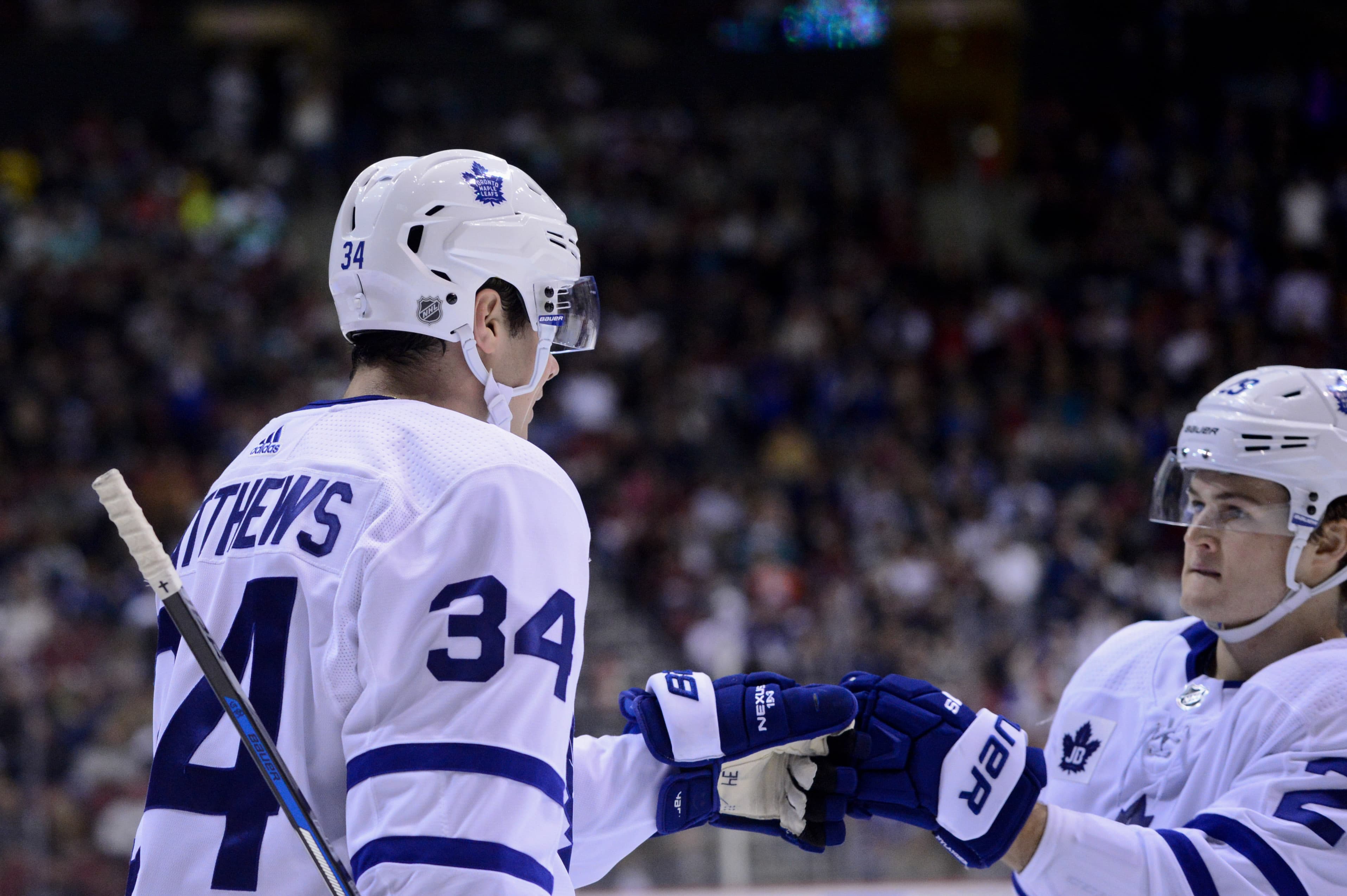
Photo credit: Matt Kartozian-USA TODAY Sports

By Ryan Hobart
Sep 2, 2018, 09:00 EDTUpdated: Sep 1, 2018, 19:09 EDT
A few months ago, I embarked on a series looking at the Leafs’ upcoming restricted free agents (RFAs) who they’ll be looking to sign this offseason. If you missed it when it started, here’s the kick-off post to give you an idea of the structure of the series. Essentially the idea is to use what information we have about the player, the Leafs’ contracting strategies, comparables, and my own gut feelings all together to give a contract projection.
We left off at Connor Carrick, and I do sincerely apologize for the extensive break.
Today, we’re going to be discussing the biggest name on the Leafs’ to-do list: Auston Matthews. It’s now September 2nd and the Leafs have still not signed Matthews to an extension. His entry level contract expires on July 1st of 2019, but he was eligible to sign an extension as of July 1st of this year. Most expect that the Leafs and Matthews will come to an agreement before the season starts, which is why I’ve included him in this year’s RFA series.
The Player
If you’re reading this blog, I shouldn’t really have to tell you who Auston Matthews is, but I’m going to do so quickly anyways.
The former 1st overall pick; the prize for tanking in 2015-16; one of two number 1 centers on the team; the rookie season 40 goal scorer; and possibly the future captain. That’s who we’re talking about today.
Matthews is a superstar for Toronto, and there’s really not much more to say besides that. We all know he’s great. How great is he, though?
The Numbers
The best way to do this is to compare Matthews’ statistics to other star centers around the league.
As much as I like shot attempt numbers like Corsi, I don’t feel they’re going to factor into the contract negotiations, so I’m going to leave them out. These negotiations are about pedigree, and whether Matthews controlled 53% or 51% of the shot attempts isn’t really going to affect his paycheck.
With 139 points in 157 NHL games (regular season and playoffs), and 119 of those primary points (goals and first assists);100 even strength points (5-on-5, 4-on-4 and 3-on-3), and 91 of those even strength points being primary points; he’s obviously an offensively dynamite player.
Over his first two seasons in the NHL, Matthews has finished 5th and 2nd in the league for goals on a per-game basis. At points-per-game, though, he finished 30th and 21st, which leaves him a little lower than some of the top centers in the game. For 2017-18, he was at least 0.1 points per game behind Connor McDavid, Nathan MacKinnon, Evgeni Malkin, and Anze Kopitar.
It’s obvious that Matthews is an effective and productive center, and belongs in the “elite” catgeory of the league, but personally I see him near the bottom of that tier, at least at this point. He still is just 21 years old, so perhaps there’s ground to be gained there. And it’s possible that that potential growth will be factored into his contract.
The Money
Below is a table of the top 25 NHL centers (as per Corsica) and their contracts. When reviewing this, it’s important to remember the difference between RFA and UFA negotiations, as the player isn’t able to shop themself around the league for a better contract.
Player | Signing Year | Expiry Status of Last Contract | Cap Hit ($M) | % of cap when signed | Term (yrs) |
Connor McDavid | 2017 offseason | RFA in 2018 | 12.5 | 16.7 | 8 |
Sidney Crosby | 2012 offseason | UFA in 2013 | 8.7 | 14.5 | 8 |
Patrice Bergeron | 2013 offseason | UFA in 2014 | 6.875 | 10.7 | 8 |
Nathan MacKinnon | 2016 offseason | RFA in 2016 | 6.3 | 8.6 | 7 |
Evgeni Malkin | 2013 offseason | UFA in 2014 | 9.5 | 14.8 | 8 |
Evgeny Kuznetsov | 2017 offseason | RFA in 2017 | 7.8 | 10.4 | 8 |
Auston Matthews | 2018 offseason | RFA in 2019 | — | — | — |
Anze Kopitar | 2015-16 midseason | UFA in 2016 | 10 | 14 | 8 |
Steven Stamkos | 2016 offseason | UFA in 2016 | 8.5 | 11.6 | 8 |
Ryan Getzlaf | 2012-13 midseason | UFA in 2013 | 8.25 | 12.83 | 8 |
Jack Eichel | 2017 offseason | RFA in 2018 | 10 | 13.33 | 8 |
Eric Staal | 2008 offseason | RFA in 2010 | 8.25 | 14.55 | 7 |
Nicklas Backstrom | 2010 offseason | RFA in 2010 | 6.7 | 11.28 | 10 |
Ryan O’Reilly | 2015 offseason | UFA in 2016 | 7.5 | 10.5 | 7 |
John Tavares | 2018 offseason | UFA in 2018 | 11 | 13.8 | 7 |
The best comparables here are Jack Eichel, who signed in a very similar situation, with slightly lower pedigree at the time, and John Tavares, who just signed with the Leafs for $11M. We can see they both signed between 13 and 14% of the cap. Since Matthews is an RFA as Eichel was, though with a better track record thus far, I think he will be around 13.5% of the NHL salary cap, which is $79.5M for the current season.
It would be strange to expect Matthews doesn’t sign for the longest term that he’s able to — 8 years. But what about the dollars? Well, 13.5% of the cap is $10.73M. As a result, this is what I expect:
Optimistic: $10.75M for 8 years
Realistic: $11M for 8 years
Pessimistic: $12M for 8 years
Final Thoughts
I admit that it’s a little boring to boil it down to this. With comparables and the % of cap hit calculation, the numbers above seem obvious. Sometimes you have to let what makes the most sense take control. It’s really difficult to suggest that the Leafs would stray from the norm and do something different than any other team in the league has done with their star center.
Hopefully we will see an Auston Matthews extension soon, at or below $11M per year, for as long as possible. Any ideas otherwise seem far fetched at best.
As we gear up for the 2018 training camp, hopefully Leafs management and Matthews can put ink to paper and get this much anticipated deal completed, and we can see just how expensive having 2 elite centers will be in this era.
This is the last of the estimate posts for the 2018 RFA series. All indications are that Marner is going to wait until next year, so I’ll wait to write his until next year’s series. Hope you enjoyed, and I’ll see you all when I do a summary post on how I did with all of my estimates!
Breaking News
- Ryan Tverberg reportedly signs 1-year, $850K extension with Maple Leafs
- Leafs development camp scrimmage notebook: McKenna’s playmaking, Koblar shines, Nansi wins superlatives, quick hits
- Gavin McKenna confirms he’ll wear No. 92 for Maple Leafs
- Instant Reaction: Maple Leafs add speed, upside on 2-year deal worth $1.55M for Emil Andrae
- Maple Leafs sign Emil Andrae to two-year contract reportedly worth $1.55M annually